
Backrooms (2026)
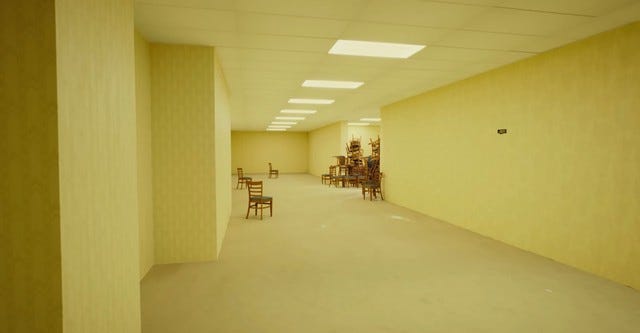
A trick of the light. Something that can only be seen from certain angles. Perhaps related to the power surges and the intermittent flickering lights and the outsized power bills. There it is again.
Clark moves forward, puzzled by the sight. It slips out of view until he moves back to the right angle. Like something alien intersecting with reality. He moves forward again, his hands pressing against the wall, searching for a hint of the scar of light that he knows he saw. He presses and then he falls into a place. Some place. That definitely wasn’t on the other side of the wall of the basement of his failing furniture store.
Clark doesn’t go into the other place because he’s brave. He goes because outside of it, he has completely run out of reasons to be anywhere at all.
He is a failed architect (he is a fucking architect goddammit), divorced and probably an alcoholic, operating a furniture store called Captain Clark’s Ottoman Empire. He knows the metaphor is confused but doesn’t seem to be able to find his way out of it. He makes terrible local access advertisements with Kat (Lukita Maxwell) and Bobby (Finn Bennett) where he dresses up as a pirate (again, despite this being an Ottoman Empire, so shouldn’t he be a sultan?).
He sees his therapist Mary (Renate Reinsve), who is generally supportive in the way that therapists can sometimes be (particularly when there is a mismatch between patient and therapist), which is to say: she provides a space for his misery without actually resolving it. He is, as the film keeps telling us, stuck in a loop. Unable to find a new path. The store is going under, partly the economy, partly those power bills that don’t add up.
And then the wall gives way, and for the first time in what appears to be years, Clark comes alive.
That’s the film’s central preoccupation and what makes it something more than a very well-executed horror picture. Most liminal space horror asks what happens when you get lost in the space between places. The Backrooms asks what happens when a man finds the in-between more inhabitable than anywhere else. What happens when the uncanny starts to feel like home.
Kane Parsons has released his… adaptation… continuation… standalone continuation… separate exploration of the same thematic vein… of his viral YouTube series. I’m not going to retread the Kane Pixels territory I covered a couple of weeks back talking around Kane and Marble Hornets and Nirvanna the Band the Show the Movie (I’ll point you to Alec Worley’s excellent piece on The Rolling Giant if you want more of that) — but the context matters: after twenty-odd YouTube videos building out the Backrooms universe, A24 gave Parsons $10 million to make a feature film. It looks set to open around $80 million. For a first feature from a filmmaker who, until recently, was operating entirely on YouTube. That’s nuts.
You know it’s good because there is a whole thing happening right now where people are accusing Parsons of not having directed it. If there is a better example of telling on yourself, I’m not sure what it is.
The accusation reveals something interesting though. The film feels authoritative in a way that people apparently can’t reconcile with someone of Parsons’ age and background, so the reasoning goes: someone else must have done it. What it actually reveals is how thoroughly those people have internalised the idea that craft has to be earned through a specific set of institutional gates. Film school, the short film circuit, a low-budget debut with whatever actors you can scrape together. Parsons didn’t do any of that. He built his craft in public, on YouTube, over five years.
And you can watch him do it. Compare “Backrooms (Found Footage)” to “Found Footage 3” and the difference is stark. The command of pacing, the atmosphere, the world and character building is night and day. He arrived at this film having already done his ten thousand hours. He just did them somewhere that a lot of people weren’t watching.
The result, with a serious slate of producers including Osgood Perkins, Shawn Levy and James Wan, and top-shelf acting talent in Chiwetel Ejiofor and Renate Reinsve, is being witness to an incredible new voice given almost unreasonably good conditions to succeed.
(There is a part of me that would love some insight into what Parsons is actually like directing actors. Ejiofor and Reinsve are exceptional enough that they’d find gold even with thin material and limited direction, which makes it genuinely hard to calibrate how much of what’s on screen is him.)
(There is also a part of me that wonders if a decade from now he will look back at the YouTube series and this film and the themes he puts forth as his juvenalia. I wonder if that thematic exploration will expands and evolve as he matures as a filmmaker and storyteller.)
The first fifty minutes or so are close to perfect.
From the opening found footage sequence of an Async researcher (a government-adjacent organisation that haunts the edges of the film, apparently dedicated to mapping The Complex) being hunted through the Backrooms, through Clark’s initial explorations, and into the found footage section where he drags Kat and Bobby in to document the space: it is a masterclass in mode and atmosphere. Stripped back. Minimalist. A different kind of horror.
Where most horror films locate terror in darkness, in the thing that can’t quite be seen, this film finds it in stark fluorescent lighting, sickly yellow wallpaper, uncanny ambient sounds, a minimalist synth score, and a space that simply will not end. The horror is not what’s hiding. The horror is the scale. The horror is that the more you map it, the more there is to map.
The YouTube series operates as an anachronic tone poem. The found footage episodes get the most views, but the rest are artefacts from within the fictional universe, pieces with limited context that function as evidence of a world rather than explanations of it. The film has absorbed that logic entirely. It trusts the audience to build understanding from texture rather than exposition. For most of its runtime, it keeps that trust.
Then it shifts to Mary’s point of view for the home stretch, and people are going to have very different views on how successful that is.
The shift is correct in a formal sense. This is a film about mirrors and doubles. It is Lynchian in the specific way Lynch is Lynchian. Not as aesthetic reference but as structural logic, a nightmare architecture of repetition and doubling where uncanny spaces reflect the psychological states of the people who enter them. Of course we end up following the character whose job was to help Clark find his way back to himself, into the space where he has gone instead.
The problem isn’t the shift. The problem is what happens on the other side of it.
Mary finds Clark deep in The Complex. Time has passed. He has gone native, a fucked up Kurtz revelling in the horror, the horror. More than that, he has devolved, or perhaps come into focus, into something harder and stranger than the man we met at the start. The film mirrors an earlier therapy scene where Mary walked Clark through a roleplay of the night his ex-wife kicked him out of his own house. Here, in a kitchen that The Complex has generated from a memory, surrounded by human-shaped things that look like people Clark once knew (including, pointedly, his ex-wife) they do it again.
It’s a strong idea. The execution is where it wobbles.
The trouble is that Clark’s transformation happens entirely off screen. We get the before and we get the after, but nothing during. And while there’s a kind of logic to that, character change at this scale needs to be dramatised somewhere or it doesn’t land properly. What we needed was some passage, some scene, something that showed us the moment Clark stopped wanting to come back. Instead we get the result of that moment presented as a reveal, and it registers as abrupt rather than unsettling.
The resolution compounds it. What follows is quieter than the film has prepared us for. There is maybe something in that. Clark realising he doesn’t need to change, Mary realising she never really could help anyone. But it arrives as deflation rather than the bleak precision it’s reaching for. The film has been pressing down on you for ninety minutes and then at the crucial moment it eases off.
Will Soodik’s script is serviceable throughout, but the third act is where its limitations become most visible. The characterisation is thin enough across the whole film that it depends heavily on Ejiofor and Reinsve to supply texture the page doesn’t necessarily provide (for most of the runtime they’re more than up to it). But in the final act, when the script needs to carry more weight, it starts to buckle.
In part this is because of the demands of shifting to a feature film format. There are necessities in doing that, in how a story is expected to arc, in the ways that stories are expected to be told by an audience that need to be met to an extent to ensure that they resonate with people beyond those that consume the YouTube series (for an example that resists this for good and ill, watch skinamarink).
What saves it, and what will sustain the film in the long run, is that the answers it provides are genuinely messy in the right way.
The Complex seems to be a psychogeography. A labyrinthine structure built from the memory of those who enter it. Clark explains it: every space that ever was, replicated from memory, and the more it remembers the worse the replications get. It populates itself with doubles. Memory people. The dining room scene, where Clark watches simulacra of people, is the clearest distillation of what the film is actually about. But also is a point where the film deflates a little.
For all that there’s perhaps too much explanation at certain points, the questions it raises are productive and the answers are messy as fuck in a way that lets the film breathe and open up.
The Complex as hell you descend into to face your own double. As an indictment of generative AI and its degraded remixing of experience. As a metaphor for the way dementia strips the sharpness from memory until what remains is a copy of a copy of a copy. As what trauma does, how it takes the actual texture of what happened and replaces it with a version you keep revising until you’re not sure what was real.
Clark doesn’t go into The Complex to find himself. He goes to find a place that doesn’t require him to be found.
Parsons’ influences are visible throughout — there’s a moment that directly recalls The Rolling Giant — but like all great filmmakers he synthesises and remixes them into something that exceeds its sources. You can point to House of Leaves (specifically the Navidson Record sections) as a direct inspiration. You can look at The Complex and find Nihei’s City from Blame! and it’s infinite growth. You can trace the found footage lineage through The Blair Witch Project and Koji Shiraishi’s Noroi: The Curse. That would be accurate and completely reductive. What matters is that Parsons has taken all of it and made something that couldn’t have been made by anyone applying those influences differently. His ability to ratchet up tension and know precisely when to pay it off is the sort of thing filmmakers much older than him would love to be able to do with such consistency.
The Backrooms sits in your gut. It is a near goddamn masterpiece. And Clark, standing in a kitchen that shouldn’t exist, surrounded by people who are made of his own bad memory, looking, for the first time in the whole film, like he’s exactly where he wants to be, is one of the stranger, more unsettling images presented to an audience in a long time.
The horror isn’t that he got lost.
The horror is that he stopped looking for the way out.
Great piece, Sean! Totally agree - the only thing that really faltered for me was that we didn't see Clark's mental unravelling. It was way too abrupt. Good thing the two leads are so great. I honestly think Backrooms and the whole 'liminal space' movement on YouTube (which one miiiiiiiight accuse Parsons of gathering under his own banner here - there's a whiff of Jared Pike's The Poolrooms and James Leyland Kirby's (aka The Caretaker's) 'Burning Memory' track) taps into a such a wealth of modern anxiety the same way Romero's concept of the zombie apocalypse did.
I think this accurately pinpoints the film's strengths and weaknesses. I wonder if what exactly happened to Clark and Kat during that period off-screen will be tackled in a sequel or web series. Like, maybe the movie is deliberately leaving these questions open to fill the gaps later.