
Good Fortune (2025)
Or, Dystopia Now
Master of None was one of the great shows of the second era of streaming originals. Conceived by Aziz Ansari and Alan Yang it ran for two seasons on Netflix (well kind of three seasons but I bet you didn’t realise there was a third season did you). The first show was a comedy that looked at race, relationships, the immigrant experience, and could be as funny as it was insightful.
The second season was even better, though it was harder to grapple with, tried to tackle #metoo (which at the time was all over the news) in a haphazard fashion, and sort of made Ansari’s main character into something near an antagonist. It also showed off Ansari’s clear love of cinema and skills as a writer/director.
Then Ansari got accused of sexual misconduct and things slightly derailed for him. In the era of #metoo, it was one of many accusations but it certainly pumped the breaks on his career.
For awhile anyway, cause a world in which Louis C.K. can come back from being accused of masturbating in front of women, why wouldn’t Ansari get to come back from his accusations?
Following a third season of Master of None (which you didn’t realise existed) being struck by COVID as all things were then, Ansari hasn’t done a huge amount. Some standup, a bit of acting. But the days of playing Tom on Parks and Rec are well in the past.
Good Fortune represents Ansari’s feature directing debut. And it’s good. Not great. Like Gervais and Merchant, one wonders whether Ansari and Yang made each other better or if Yang had most of the talent (like with Merchant - though I’ve seen Yang’s follow up show and it’s real meh).
Ansari plays… someone. Look, he’s got a name but really it’s kind of the standard character that Ansari has cultivated over his career, though more to the Tom end of the spectrum than the Dev end.
Meanwhile, Seth Rogen plays… look, he plays kind of the Rogen character that Seth has cultivated over the past decade or so. That kind of a bit bewildered, sort of slacker, weird laugh guy (you ever hear him on a podcast? He comes across exactly how you would expect). But, his character is really rich. A Hollywood Hills VC type tech bro (but if Seth Rogen was a tech bro).
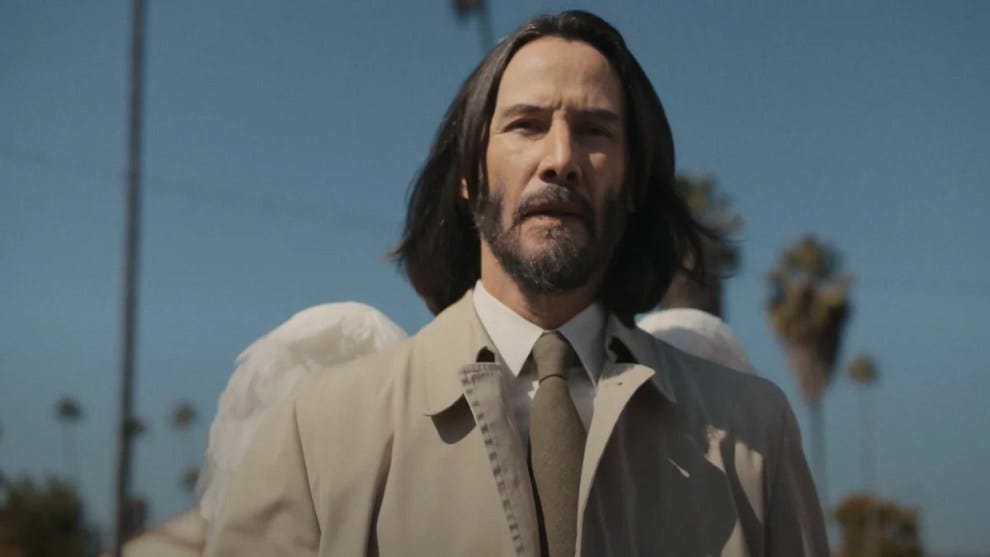
And Keanu Reevs is here playing… essentially his robotic, strangely reacting to the world around him thing that is the throughline of his career from Bill and Ted to The Matrix to now. But he’s an angel who has very small wings.
Yes, there is kind of a vein of homage to Wings of Desire running through this movie which I definitely didn’t expect. Anywho, he’s a guardian angel for people who text and drive. But he wants to be so much more.
Aziz is a gig economy worker. He waits in line at the new cinnamon bun place to pick up for someone who has ordered through the movie’s version of Uber Eats. He says that he’s a documentary film editor (but he’s freelance and between gigs). He works about half a dozen jobs, all trying to make a living.
Seth is rich as fuck and hires Aziz as his assistant. It’s going great. Aziz is totally equipped to be Seth’s assistant. But Keanu concerned that Aziz is very depressed. Plus Seth fires Aziz as his assistant cause he spent a few hundred dollars of Seth’s many millions of dollars.
That’s right people, it’s a buddy comedy that takes aim at the hyper capitalist state! It’s also a body switch comedy. Kind of. It’s not straight body switch but it’s definitely inhabiting the other person’s life. Plus, cause he got involved, Keanu loses his wings and becomes human and discovers chicken nuggies and milkshakes.
It’s actually quite amusing and can be rather pointed about the yawning gap in wealth inequality in the US (and other developed countries but particularly the States) right now.
But it’s also a little too unfocused. Aziz’s romantic interest is trying to unionise the hardware store she works at - but that’s just a minor plot thread. It’s all kind of minor plot threads that feature touch points of late stage capitalism and the gig economy. There is plasma donating. There is working multiple jobs. There is sleeping in your car and showering at the gym. At times it feels like a less edgy version of Superstore (don’t at me but that show was aggressively political for all that it was goofy as fuck).
The main throughline is that Aziz gets to live out Seth’s life, Seth has to live out Aziz’s life, and ultimately the plan is that they both recognise how good they both have it and Aziz will want to go back to his life and Keanu can get his wings back and it will all be happily ever whatever.
Except… the film makes a really strong and compelling argument that Aziz’s life was pure shit. He loses his car because he got kicked out of Denny’s where he fell asleep cause he donated plasma so he would have enough money.
So Aziz doesn’t want to go back to his old life. And Seth has discovered how bad Aziz’s life is and definitely wants out.
But then the film realises it probably needs to wrap things up so they swap back and the film has the most asinine, borderline offensive ending montage cause don’t worry you guys, Aziz has found happiness in his old life, and Seth has realised that he could treat his workers better, and all the gig economy workers rise up and leave their shitty jobs and… something something… profit.
I’ve always believed that a bad ending is just one part of a film and if the journey there has been good enough then it doesn’t matter if they don’t stick the landing. And I still believe that but there is something about this ending that I just cannot let go. I think it’s cause it completely contradicts the message of the rest of the film. And I think it’s cause it’s fucking baby town frolics in it’s understanding of late stage capitalism.
Cool beans, Seth thinks he could treat workers better. Amazing.
Aziz and his gig economy workers leave their jobs. Cool!
But it’s all systemic forces that have created the environment that has lead to hyper capitalism. The gig economy wasn’t the disrupting factor, the gig economy was the natural end point of capital and labour under the hyper capitalist state.
The film is fine. It’s cute even. There are laughs to be had. Keanu is a freaking treasure and will remain so until he dies (even if his face and eyes are starting to look like they are crying out for a dramatic role).
But it all got me thinking on dystopian fiction.
Because as much as its a comedy. As much as its an almost body switch movie. It’s also clearly a work of dystopian fiction.
Because we are living the dystopia now. Except, much like living in the future, we don’t realise that we are there.
The movies (and books and TV) taught us that dystopias look a certain way. It’s always night time. And it’s mostly raining. There’s usually a lot of smog. Maybe Harrison Ford is eating noodles in the rain on the side of the road. It’s all very grim and no one is having a good time.
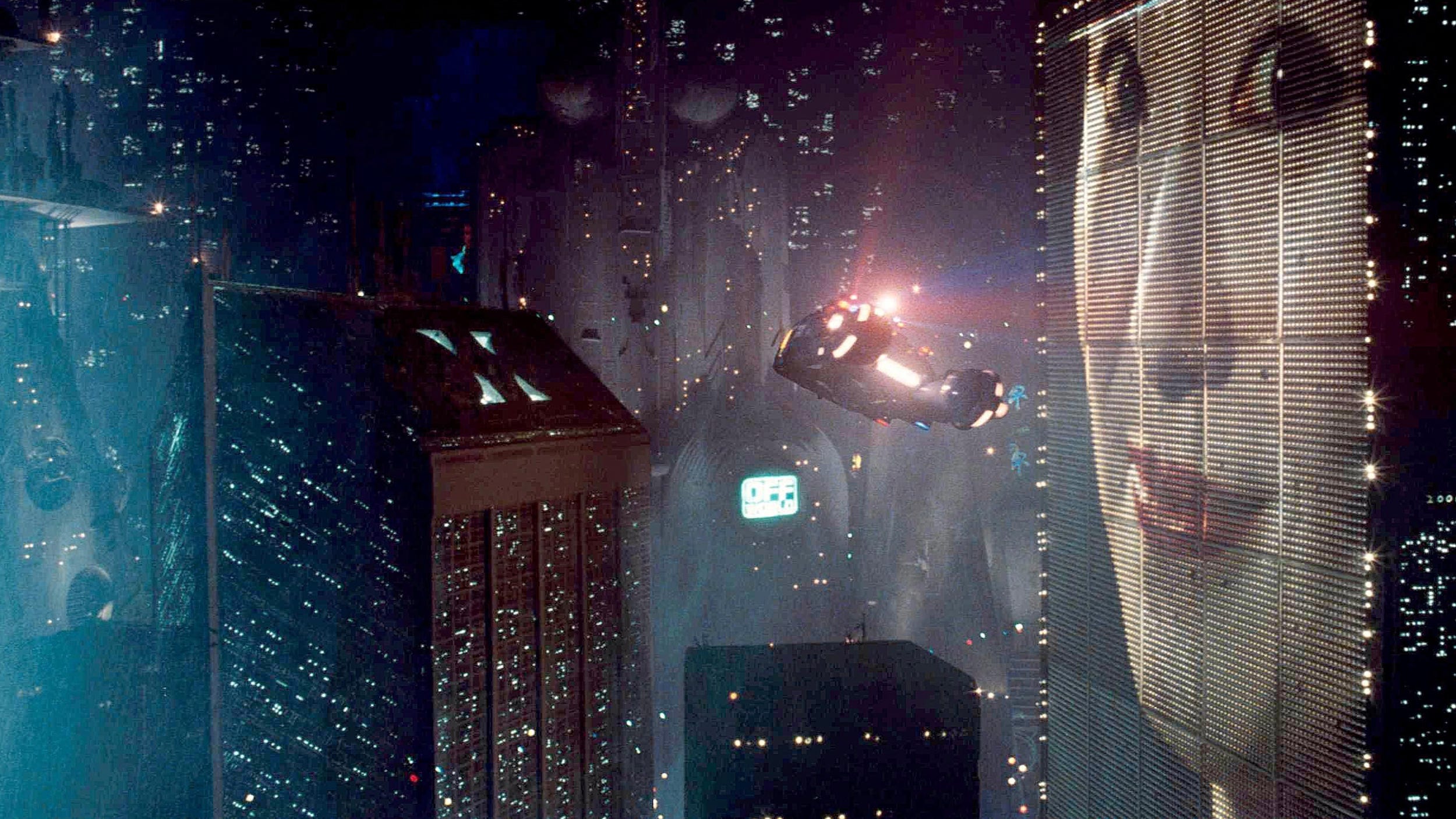
We probably would have flying cars though.
Except, we’ve been there the whole time. We exist in an information dense, panopticon of a nightmare. Where we gladly allow ourselves to be tracked, and give up all the metrics that define us, cause we might get some coupons for shopping?
And the world is burning but it’s usually not where we are. And even if we are, a lot of the time the weather is really pleasant, just a bit chaotic. And we kind of just accept that we have easier lives because of a system that approaches chattel labour.
But the sky is blue, and hey, there’s always a chance we might end up in a situation where we are on top and things won’t be so bad anymore. Then we’d be able to afford all the things and that would be great cause that’s why we have jobs and keep turning up to an office that is almost certainly made of glass despite being in a climate where there is a lot of sunshine year round and so the AC needs to be cranked the whole time and our boss mostly hates us but will only tell us that on Tuesdays and some Fridays and we raise our kids with weird things like the tooth fairy so they understand from a young age about the comodification of our own bodies because when our labour doesn’t produce enough for the capitalist state then we may as well cash in our bodies.
But the sky is blue. So we don’t realise it’s a dystopia. And we don’t realise dystopian fiction when it’s in front of us because it looks like our lives.